Bank of England: will rates rise on 5 November 2026?
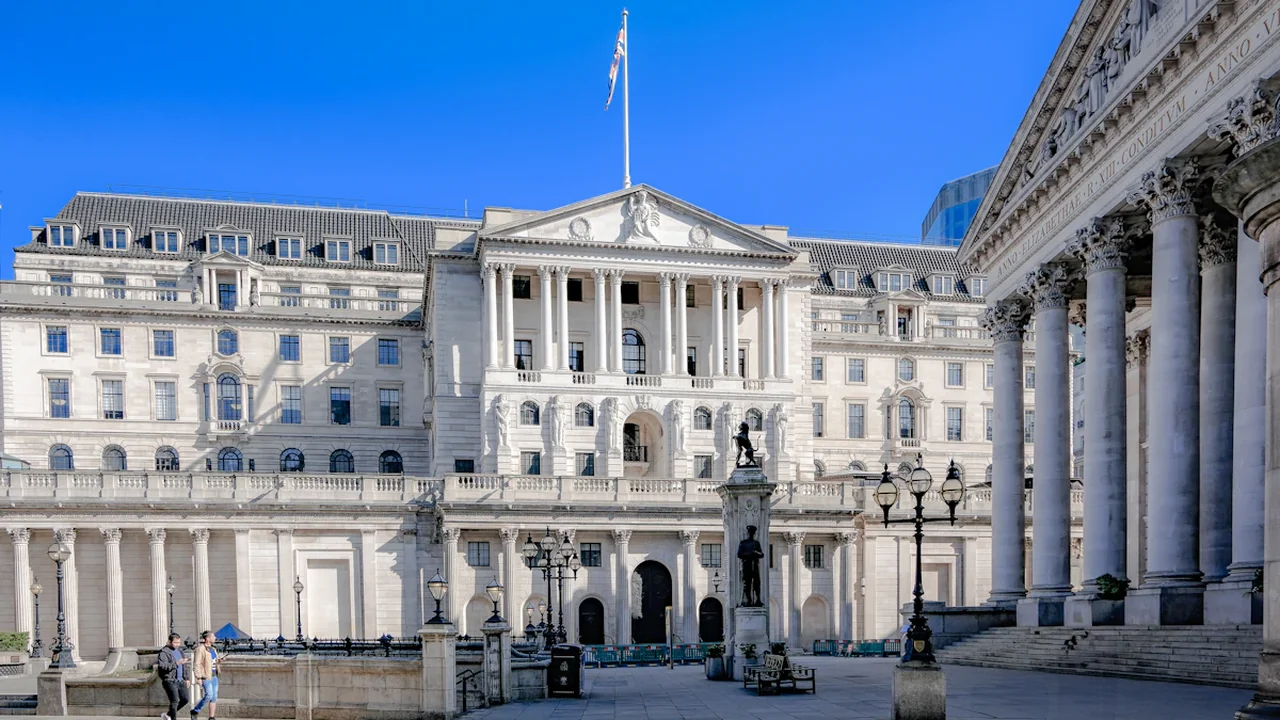
The Bank of England held Bank Rate at 3.75% in September 2026, but three of its nine Monetary Policy Committee members wanted an increase to 4%. That split matters to UK households reviewing mortgage payments and savings returns ahead of the scheduled 5 November decision. Participation in Pink River’s forecast closes at 23:59 Europe/London on 4 November, before the announcement, so readers must make their prediction while the outcome remains unknown.
By Pink River Editorial | 7 October 2026
The November decision and the participation deadline
The question is specific: will the Bank of England’s official scheduled November decision set Bank Rate above 3.75%? It concerns the rate announced by the Bank, rather than the price of any particular mortgage or savings account.
- Question: will Bank Rate rise above 3.75% at the scheduled 5 November 2026 decision?
- Deadline: participation closes at 23:59 Europe/London on 4 November 2026.
- YES: the official decision sets Bank Rate above 3.75%.
- NO: the official decision sets Bank Rate at or below 3.75%.
- Settlement: the Bank of England’s published decision determines the result.
The Bank’s monetary policy page, dated 16 September 2026 in the supplied evidence, lists 5 November 2026 as the next decision date. It also states that decisions and minutes are published at noon on announcement days.
Closing participation the previous night separates predictions from the published answer. Pink River participation is for reputation and engagement only. The useful household question alongside it is how an increase, hold or reduction could interact with existing borrowing and savings terms.
September’s 6–3 vote leaves competing paths open
The Bank of England’s September decision and minutes, published on 17 September 2026, record six members voting to maintain Bank Rate at 3.75%. Three preferred a 0.25 percentage point increase to 4%.
The majority supported holding at that meeting. The dissent shows that an increase also had support within the committee. These are competing signals from one decision, rather than a guarantee that either group will prevail in November.
A YES outcome would require the committee’s next scheduled decision to move the rate above the September level. A NO outcome could follow either another hold at 3.75% or a reduction. The question therefore distinguishes an increase from every outcome at or below the threshold.
September’s vote should not be converted into a numerical probability for November. Six hold votes out of nine do not establish a two-thirds chance of another hold. Members make a new decision, and their assessment can change between meetings.
Nor do the three increase votes establish that 4% is the only possible YES result. Any officially announced Bank Rate above 3.75% satisfies the question. The dissenting preference explains the September disagreement; the November announcement supplies the answer.
Mortgage effects depend on the contract households already have
Bank Rate is the Bank of England’s policy interest rate. It influences borrowing conditions, but it is not a universal mortgage rate. The connection to a household’s monthly payment depends on the product, its terms and when any contractual change takes effect.
Tracker and variable mortgages
For a mortgage explicitly linked to Bank Rate, the agreement should explain the relationship between the policy rate and the mortgage rate. It may specify a margin, an adjustment timetable or other conditions. Those details determine how an announced change reaches the borrower.
A lender’s standard variable rate works differently. Its pricing and notification terms need to be checked directly. Households should not assume that a 0.25 percentage point Bank Rate increase would produce an identical increase across all variable mortgage products.
Fixed mortgages and upcoming renewals
An existing fixed mortgage generally keeps its agreed interest rate during the fixed period, subject to its terms. The more immediate issue may be when that period ends and what rate applies afterwards. A November decision does not itself rewrite an existing fixed agreement.

New fixed mortgage offers can also reflect funding costs, expectations and lender decisions. Their prices may change before or after an announcement. Even a correctly predicted Bank Rate outcome cannot promise a particular renewal offer or payment.
The practical checks are the mortgage type, fixed-period end date, rate linkage, notification arrangements and any charges attached to changing the agreement. These details make the decision relevant to an individual budget without turning the forecast into a recommendation to switch or wait.
Savings returns also depend on account terms and notices
A higher Bank Rate can affect the environment in which providers price savings accounts. It does not guarantee that every account will pay more, that providers will act immediately or that they will pass through the full increase.
Variable savings accounts may have their own rate-change provisions. Fixed savings products usually specify a rate for an agreed term. Accounts with introductory bonuses, notice requirements or withdrawal conditions need additional attention because the headline rate may not describe the whole arrangement.
For savers, the relevant document is the provider’s account information or rate-change notice. A Bank of England announcement explains the policy decision; the provider’s terms explain what happens to the account. The two should be read separately.
Useful details to check include:
- Whether the account rate is fixed or variable.
- When an introductory bonus or fixed term ends.
- How and when the provider communicates rate changes.
- Whether access restrictions or withdrawal conditions apply.
Households may have savings and a mortgage at the same time. A policy increase could affect both sides of their finances, but not necessarily on the same date or by the same amount. Neither the September vote nor this forecast establishes the net effect for an individual household.
The official rate determines YES or NO
Settlement uses the Bank of England’s published decision for the scheduled November meeting. The announced Bank Rate is compared with 3.75%. Mortgage advertisements, savings notices, commentary and changes in market expectations do not determine the result.
A decision setting Bank Rate at 4% would resolve YES. A hold at 3.75% would resolve NO, as would a reduction below that level. These examples illustrate the threshold without predicting which announcement will occur.
The accompanying vote and explanation will help readers understand the decision, but they do not replace the rate test. A hold with several members preferring an increase would still resolve NO. An increase would resolve YES regardless of the size of the majority supporting it.
If the scheduled decision is postponed, settlement is suspended until that decision is published. The passing of 5 November without an announcement does not establish NO. If the decision is cancelled, participation must be voided rather than assigned a NO outcome.
Noon on 5 November is the next household check
The next decisive public fact is the Bank of England’s scheduled noon announcement on 5 November 2026. Until then, September’s 6–3 split supports a discussion of competing outcomes, while leaving the next rate unresolved.
Readers can use the time before the announcement to locate their mortgage agreement and latest savings notices. After publication, compare the official rate with the relevant contractual terms and any provider communication. That check connects the national decision to the dates and conditions that actually govern household payments and returns.
Source: Bank of England
Context & actions About this article
Source check Decision and deadline
The September vote and November schedule come from Bank of England publications; the official scheduled November decision determines the forecast result.
- The 17 September 2026 decision records a 6–3 vote to hold Bank Rate at 3.75%.
- Three members preferred an increase to 4%.
- Participation closes at 23:59 Europe/London on 4 November 2026.
- Postponement suspends settlement; cancellation requires voiding.
- Source
- Bank of England September 2026 decision
- Scope
- United Kingdom
- Updated
- 2026-10-07 11:43
Source check
Report a trust issue
Send a clear signal to community moderation if the source, facts or context need review.




Comments