The Gunpowder Plot: Why November 5 Still Matters

On November 5, 1605, authorities uncovered a plan to blow up the House of Lords during the state opening of Parliament. Guy Fawkes was one of the conspirators, but the plot involved a wider group. Its failure became the reason for an annual commemoration that has changed meaning over the centuries.
The date is still familiar because bonfires and fireworks have kept the story in public view. To understand what November 5 commemorates, it helps to begin with Parliament itself: the target was not a general government building, but the chamber where the Lords were due to gather with the king and other political leaders.
Why Parliament was the target
The Gunpowder Plot was a conspiracy to destroy the House of Lords at the state opening of Parliament. The UK Parliament’s historical account identifies Guy Fawkes as one of those involved, rather than the sole author of the scheme.
The planned attack placed the ceremony at the center of the plot. The Lords would be assembled for the opening, making the chamber a target at a moment when the monarchy and Parliament were together. The intended explosion would have killed many people and struck at the governing order.
The plot belonged to a period of deep religious and political division in England. The conspirators were Catholic, and their plan was directed against a Protestant monarchy and a political settlement they opposed. That context helps explain the plot’s aims, but it does not make the conspirators’ actions representative of Catholics as a whole.

Parliament’s setting matters to the story. The House of Lords was the intended target, and the state opening gave the attack its planned moment. Remembering those details keeps the event anchored in its political purpose instead of turning it into a simple tale about a man with a lantern.
Guy Fawkes was one of several conspirators
Fawkes is the name most closely attached to the plot, in part because he was found guarding the explosives beneath the House of Lords. But the conspiracy was collective. Other men helped plan and support it, and the plot cannot be understood by treating Fawkes as its only participant.
His name became especially visible through the ritual of November 5: the burning of an effigy known as “the Guy.” That custom helped make him the familiar face of the commemoration. It also narrowed public memory, giving one person a starring role in a scheme planned by several conspirators.
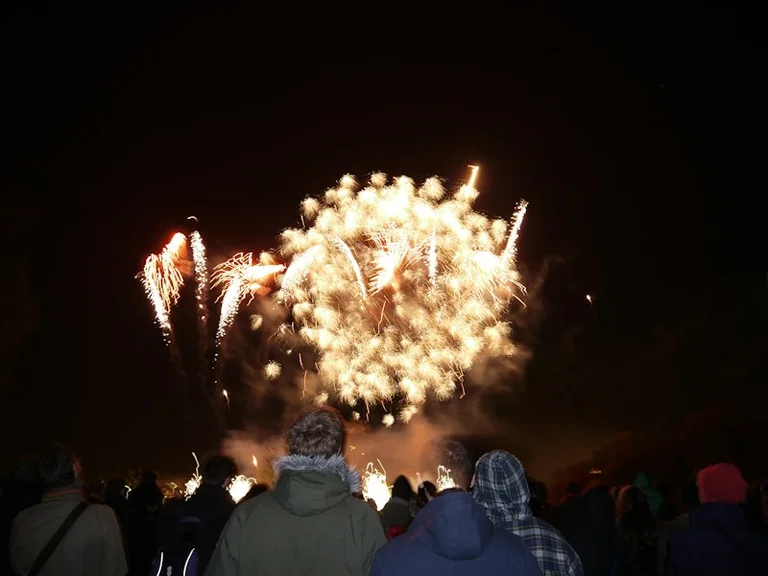
The distinction is useful when encountering familiar images of the event. A figure of Fawkes, a bonfire or a fireworks display refers to a wider failed attack on Parliament. The popular shorthand captures one part of the story, but it leaves out the political setting and the other people involved.
How the failed plot became an annual commemoration
The failure of the plot became a date for public remembrance. November 5 was associated with thanksgiving for the king’s survival and the prevention of the attack. Over time, public observance developed around bonfires and, later, fireworks, while the “Guy” effigy gave the night a recognizable figure.
The commemoration has never carried only one meaning. At different times, it could express loyalty to the monarchy and Protestant state, serve as a public ritual, or become a local night of gathering and spectacle. Customs also varied by place and era. The familiar modern shorthand, “Bonfire Night” or “Guy Fawkes Night,” does not tell the whole history of those changes. For more on November 5’s history, consider how the date’s meanings shifted over time.
That shifting meaning is part of why the date remains culturally familiar. People may recognize the fireworks without knowing the parliamentary setting, or know Fawkes’s name without realizing he was one member of a larger conspiracy. The same annual ritual can preserve an event while simplifying its causes.
What November 5 remembers today
The date brings together two different kinds of memory: the specific plan to destroy the House of Lords in 1605, and the later traditions built around the plot’s failure. The first is a political event with a clear target and a group of conspirators. The second is a changing public observance shaped by custom and the meanings people attached to it.
Keeping those layers in view makes the story more than a seasonal image. The plot was aimed at Parliament during a major state ceremony; Fawkes was among those involved; and the annual commemoration turned that failed attempt into one of Britain’s best-known dates in public memory. The UK Parliament’s historical account provides a starting point for understanding the event and its setting.
Source: UK Parliament
Context & actions About this article
Source check Historical context
The UK Parliament’s historical account identifies the plot’s target and Guy Fawkes’s involvement.
- The plot targeted the House of Lords
- The planned attack coincided with the state opening of Parliament
- Guy Fawkes was one of the people involved
- Source
- UK Parliament
- Scope
- United Kingdom
- Updated
- 2026-10-23 10:38
Source check
Report a trust issue
Send a clear signal to community moderation if the source, facts or context need review.



Comments